

How Small Screens Power Big Solutions at Our Evergreen® Company
- David Anderson
- Mimo
Today’s tech industry is defined by scale, speed, and relentless competition. It’s easy to assume, therefore, that only the largest players can stay ahead. The reality, however, can look quite different. At Mimo, we are a small, privately held company competing against global giants and low-cost manufacturers. Our success has not come from trying to match scale, but rather from staying in our lane and leaning into our engineering expertise to become the best at what we do.
Small or large, effective innovation is required for success, and even for survival, in tech; that much is universal. But our approach to innovation fits us. We are focused, patient, nimble, and disciplined, and we adopt a long-term orientation that allows us to innovate in ways our competitors cannot. To make this possible, we have embraced being a niche player.
Early on—about 15 years ago—we made an intentional strategic decision to focus on a segment of the market that we saw was underserved: small-format displays, specifically in the 7- to 32-inch range. This focus created clarity. Our larger competitors offer a range of standardized products, and small screens are just one of a great many they sell. But we find that people are rarely just looking for just a screen – they are looking to solve a problem. Further, the specifics of the best solution to their problem vary widely. We opted, therefore, for depth instead of breadth.
A single screen size might come in dozens of variations, each tailored to specific use cases such as kiosks, conference rooms, embedded systems, or transportation environments. A company with a vast range of products typically only makes one, or at most a few, options in this size range. A generic small screen might be workable, but it is rarely optimal. And with technology evolving as quickly as it is, what is ‘just right’ is constantly changing as well. Big companies don’t find it is worth their time and effort to dive into the complexities this causes, but we embrace them. This is our specialty.
In thinking about our approach to innovation, I think the best way to articulate it is that we operate under the assumption that the moment we let ourselves become a commodity, we’re already in trouble. Once that happens, price becomes the only lever and, for a smaller company, that’s a losing game. As a result, we are committed to never standing still.
Like everyone else, we are always looking for what’s next, but we know we can’t win by outspending our competitors. So we think differently. One strategy that has worked very well for us is less about inventing entirely new technologies and more about reimagining what already exists.
In one recent case, we identified a problem in conference room design; the limitations of USB-based systems restrict distance and create complex, “ugly” setups. You may have experienced this yourself – with cords that are never long enough and attachments that vary widely, it can be messy. The underlying technologies to solve this problem already existed. With our “AV over IP” solution, we were able to eliminate the messy and inconvenient cables by making it possible for audio and video signals (AV) to travel over standard network infrastructure (IP). We didn’t really create anything new; we simply lifted a solution from one use and applied it to a new one, for which it had not originally been intended. This ability to reinterpret and ‘misuse’ technology, applying it in novel ways, has become a defining capability at Mimo, and earned us our first patent.
Another advantage we have been able to create over our competition is our ability, thanks to the fact that we are private, to invest in innovations that won’t necessarily yield immediate results. Without outside investors demanding immediate and ever-increasing returns, we can afford to be patient. During the COVID-19 pandemic, for example, the market for conference room technology collapsed. Many companies pulled back, but we did the opposite. We doubled down. When people came back to offices, as a result, we were miles ahead of the rest of the field, which led to significant customer wins that would not have been possible otherwise.
Our small size itself has become another source of competitive advantage: flexibility. We can pivot pretty quickly because we’re small. Again during Covid, when traditional markets slowed, we were able to shift quickly toward sectors that were still investing, such as healthcare. This kind of agility is common among smaller businesses, and for us it’s paired with a clear strategic framework: stay focused, follow demand, and adapt without losing identity.
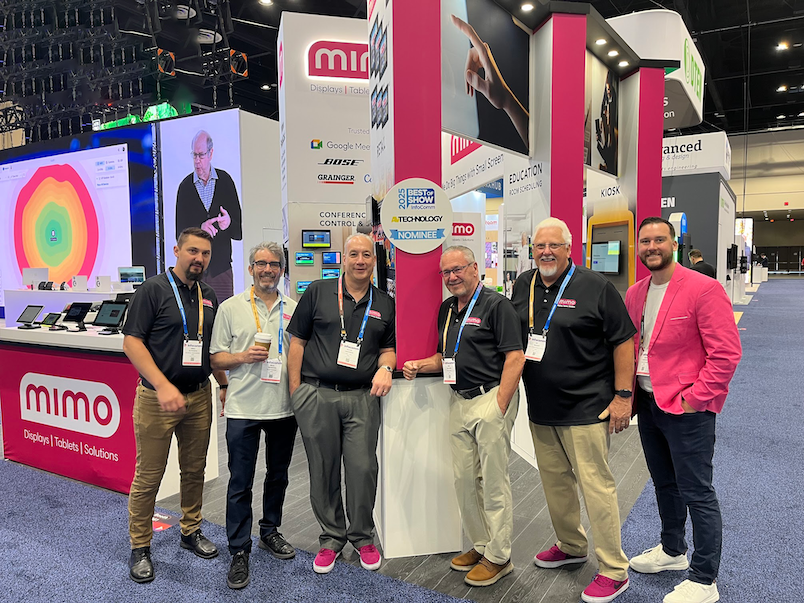
Perhaps the most understated but critical element of our approach to innovation is our relationship with customers. Innovation doesn’t happen in isolation; it emerges from constant interaction, feedback, and problem-solving. We maintain a short path between customer insight and decision-making, ensuring that ideas are grounded in real needs. As CEO, I regularly work trade show booths, engaging with end users firsthand rather than relying solely on filtered information. That’s my opportunity to talk to the end users directly and understand the problems they face day to day. A larger company would never do that, but I believe deeply that it helps us stay more connected to and aware of the needs of our users. This proximity allows us to identify opportunities early, understand nuances that might otherwise be lost, and ensure that innovation is always tied to practical value.
Being small is not all about advantages. It also imposes constraints. We don’t have large engineering teams waiting to execute on every idea. We can’t outspend competitors or flood the market with new products. Our limitations reinforce the need for focus and follow through. We can’t throw spaghetti at the wall. We have to be more intentional.
Taken together, these elements—niche focus, patient investment, flexibility, and close customer relationships—form a cohesive system. They are not isolated tactics, but expressions of our broader Evergreen® philosophy. We are not trying to win by being the biggest, the fastest, or the cheapest; we are trying to win by being focused, thoughtful, and durable.
More Articles and Videos

Leaning into Data to Build an Evergreen Company
October 20, 2026
What George Washington Can Teach Evergreen Entrepreneurs
October 13, 2026
Building a Succession Plan That Fits
October 06, 2026